
Homeowners' pick for heating and cooling across the Arkansas Ozarks and Little Red River country
Ice on the Indoor Coil
You went to check a vent and felt barely any air, or you looked at the indoor unit and saw a block of frost on the coil. The AC is running and running, and the house never gets cool. Ice on an indoor coil almost always means airflow trouble or low refrigerant. Here is what it means, what you can safely check, and when to call us for air conditioning repair.
Call (888) 381-2953- A real person answers
- Open 7 days
- Written quote before work starts
Taking calls until 5:00 PM CT
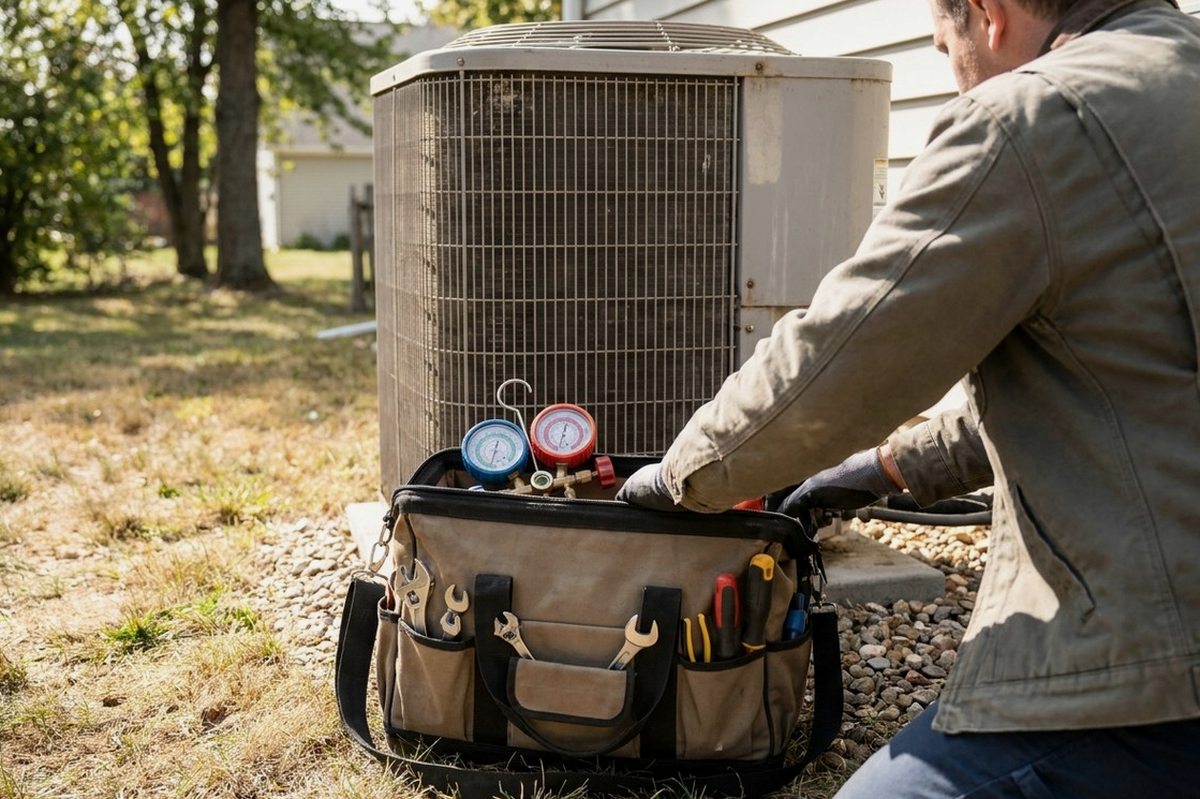
Ozark Comfort Heating & Air service team · field-reviewed before publishing
What Ice on the Coil Actually Tells You
A frozen evaporator coil means the coil is getting colder than it should because it is not absorbing enough heat from your air. Either not enough air is moving across it, or there is not enough refrigerant in the system to carry heat away properly. Once frost starts, it snowballs. Ice blocks the fins, airflow drops further, and more ice forms. That is why a system can go from weak airflow to a solid white block in a few hours. The first move is to shut the cooling off at the thermostat and let it thaw. Running a frozen system pushes liquid refrigerant back at the compressor, and compressors are the expensive part.
Cause One: A Dirty Filter or Blocked Return
This is the cheapest cause and the most common one we find on service calls across Arkansas, Missouri, Mississippi, Oklahoma and Tennessee. A filter loaded with dust chokes the air the coil needs. Same story with closed supply vents, furniture over a return grille, or a return filter someone forgot about in a hallway ceiling. On rural routes we see filters stretched three or four months past due because the box is hard to reach. Pull the filter and hold it to a light. If you cannot see light through it, that filter is your problem. Change it, let the coil thaw fully, then restart and see if airflow comes back strong.
Cause Two: Blower and Duct Problems
If the filter is clean and the coil still freezes, the air may not be moving for a mechanical reason. A blower wheel caked with dust moves a fraction of the air it should. A slipping belt on an older unit, a failing blower motor, a bad capacitor, or a control board that will not bring the blower up to speed all cause the same symptom. Ductwork matters too. Crushed flex duct in a crawlspace, a disconnected trunk line dumping cold air under the house, or undersized returns starve the coil. These are diagnosis jobs, not guesswork. We measure static pressure and blower amps rather than assuming.
Cause Three: Low Refrigerant, and Cause Four: The Metering Device
A system low on refrigerant runs the coil colder in spots and ices up, usually starting near one corner or at the suction line. Low refrigerant means a leak, because refrigerant does not get used up. Adding more without finding the leak just buys you a few months. A restricted or failing metering device, the piston or expansion valve that feeds the coil, does much the same thing. Both require gauges, refrigerant handling and leak detection. There is nothing safe for a homeowner to do here, and no part of it is a parts-store fix. Call us for air conditioner repair and we will find where it is going.
What You Can Safely Check, and What We Do Differently
Safe homeowner checks: turn the thermostat to off or fan-only so the coil can thaw, check thermostat batteries and settings, look for a tripped breaker, change the filter, open closed supply vents, and clear leaves and grass clippings away from the outdoor unit. That is the list. When we arrive for AC repair we thaw the coil, then measure superheat and subcooling, check static pressure across the coil, test blower performance, inspect the drain pan and line so the melt does not flood a closet, and leak-search the system if refrigerant is low. Hill-country travel time means we bring common blower parts and capacitors on the truck.
When it is time to book
Ice on the Indoor Coil — what people ask
Can I chip the ice off the coil to speed things up?
No. Coil fins and tubing are thin aluminum and copper, and a screwdriver punches a refrigerant leak fast. Shut cooling off, run the fan only, and give it several hours to melt on its own.
How long does a frozen coil take to thaw?
Usually two to eight hours depending on how much ice built up. Running the blower with cooling off speeds it along. Watch the drain pan and floor, because all that ice becomes water that has to go somewhere.
It thawed and now it cools fine. Do I still need a technician?
Yes, if you did not find an obvious cause like a filthy filter. Freezing is a symptom, and low refrigerant or a weak blower will bring it back. Better to find it before a hot week.
How it works
- Step 1
Tell us the symptom
Call or fill in the quote form with what the system is doing. Warm air, no air, short cycling, a smell, a breaker that keeps tripping. That detail helps us load the right parts before we roll.
- Step 2
We schedule around travel
Hill-country routes take time, so we give you a realistic window instead of a guess. If you are on a long county road, we tell you that up front and keep you posted if the day shifts.
- Step 3
Diagnose, then explain
We test the system, find the actual fault and walk you through what failed and what the repair involves. You decide before we start. If a part has to be ordered, we say when it lands.
- A real person answers
- Open 7 days
- Written quote before work starts
Why homeowners call us
- Older systems are normal herePlenty of homes on our routes run a heat pump from two decades back, a propane furnace and a wood stove for the cold snaps. We repair what you have rather than pushing you toward replacement on the first visit.
- Heating and cooling bothSame crew handles air conditioning repair in summer and heating repair in winter. That means we know your system's history when the season flips, and we are not learning your ductwork from scratch in January.
- We say what we do not knowIf a fault is intermittent, we tell you that instead of replacing parts on a hunch. Sometimes the honest answer is a monitoring period or a second visit when the weather brings the problem back.
- Regional coverage, local paceWe cover Arkansas, Missouri, Mississippi, Oklahoma and Tennessee. Travel time is part of every job we quote, so you get a window that accounts for the drive rather than a promise that falls apart.
- All major brands, gas & electricEvery major HVAC brand, gas and electric, handled by an independent crew.
- Straight answersNot worth fixing? We say that out loud, and often it saves you the visit fee.
About this guide
Safe checks done and it still misbehaves? That's a real fault
Mention which checks you ran when you book; it speeds up the visit.
- A real person answers
- Open 7 days
- Written quotes
- All major brands
- Gas & electric
Rather not call? Get a free quote →