
Homeowners' pick for heating and cooling across the Arkansas Ozarks and Little Red River country
Heating Season Prep, Step by Step
You flip the thermostat to heat some cool October morning, and either nothing happens or the house fills with a burnt smell. That is the moment most people find out something quit back in April. A little checking before the first cold snap tells you whether you need heating repair now or can wait until the weather turns.
Call (888) 381-2953- A real person answers
- Open 7 days
- Written quote before work starts
Taking calls until 5:00 PM CT
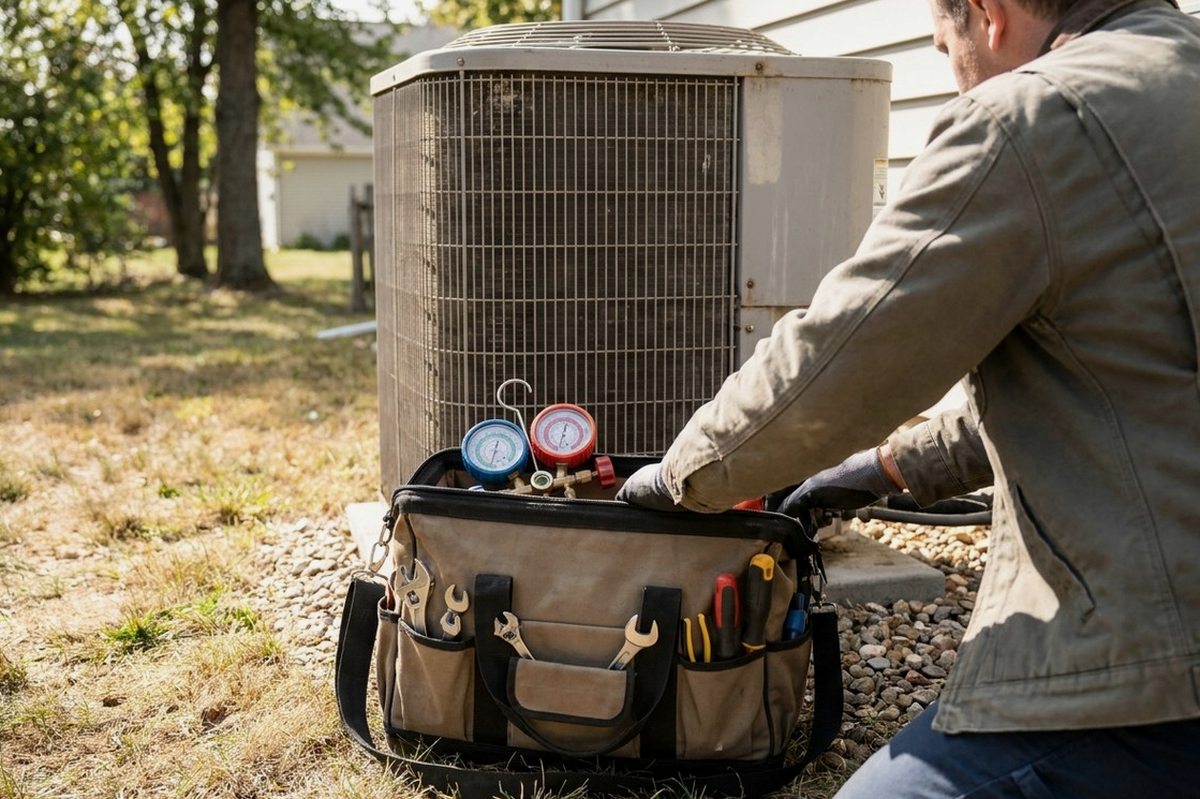
Ozark Comfort Heating & Air service team · field-reviewed before publishing
What the off-season does to a heating system
Your furnace or heat pump sat idle for five or six months while dust settled on the burners and the blower wheel. In the hill country, that idle time also means mice in the ductwork, wasp nests in flue caps and squirrels chewing on thermostat wire in crawl spaces. Humidity works on metal too. A flame sensor that read fine in March can be coated enough by fall to shut the burner down after eight seconds. Heat pumps get their own problems, mostly a reversing valve that has not moved position since spring and a defrost board that quietly failed. None of this shows up until you ask for heat.
Which failures spike, and when
Late September through October we mostly get no-heat calls on things that died over the summer: bad ignitors, dirty flame sensors, failed inducer motors, thermostats with dead batteries. Those are cheap to catch early. The first hard freeze, usually November, brings the second wave, and it is heavier. That is when marginal blower motors give out under a full load, propane regulators freeze up and older heat pumps run auxiliary heat constantly because the outdoor unit is not doing its share. January calls tend to be cracked heat exchangers and compressors. Travel time across our routes is real, so the earlier in the season you call, the sooner we get to you.
Safe checks you can do yourself
Start with the thermostat. Fresh batteries, set to heat, and the temperature set several degrees above the room reading. Then look at your breaker panel for anything tripped, including the switch for the furnace or air handler. Change the filter, since a clogged one makes a good furnace act broken. Walk the house and confirm supply and return vents are open and not blocked by furniture or rugs. If you have a heat pump, clear leaves, grass clippings and anything stacked against the outdoor unit. That is where homeowner checks stop. Anything involving gas piping, refrigerant or high-voltage parts is our work, not yours.
Propane and wood backup in older homes
Plenty of houses across the region run propane heat with a wood stove for the cold nights, and that combination needs a look before you fire either one. Check your propane level early, because tank deliveries get slow once everybody calls the same week. If you use wood backup, have the flue looked at and keep combustibles clear. Most important: if you ever smell gas or that rotten-egg odor, or your carbon monoxide alarm sounds, get everyone out of the house first. Call 911 or your gas utility from outside. Call us after the building is cleared and safe. Working carbon monoxide alarms on every level are not optional in a house with combustion heat.
When to call us instead of waiting
Call for heater repair if the system runs and then shuts off after a short cycle, if the burner lights and drops out, if you hear grinding or a rattle from the blower, or if the house never reaches the set temperature. Same goes for a heat pump running constantly on backup heat or an outdoor unit that ices over and stays iced. We work on furnaces, heat pumps and air handlers across Arkansas, Missouri, Mississippi, Oklahoma and Tennessee, and we handle air conditioning repair on the same visit if your AC gave you trouble last summer. Tell us what you heard, smelled or saw and we will bring the likely parts.
Heating Season Prep, Step by Step — what people ask
How early should I run the heat to test it?
Pick a cool morning in September or early October. Set the thermostat to heat, let the system run fifteen or twenty minutes, and pay attention to smells and noises. A brief dusty odor is normal. Anything else, call us.
Why does my furnace smell like something burning the first time it runs?
Usually it is dust burning off the heat exchanger, and it clears within a few minutes. If the smell is sharp, electrical, plasticky, or lasts longer than a couple of cycles, shut the system off and call us.
Does a heat pump need pre-season attention too?
Yes. Clear debris and vegetation from the outdoor unit, change the filter, and watch whether the system holds temperature without leaning on backup heat. Constant auxiliary heat in mild weather means something needs looking at.
How it works
- Step 1
Tell us the symptom
Call or fill in the quote form with what the system is doing. Warm air, no air, short cycling, a smell, a breaker that keeps tripping. That detail helps us load the right parts before we roll.
- Step 2
We schedule around travel
Hill-country routes take time, so we give you a realistic window instead of a guess. If you are on a long county road, we tell you that up front and keep you posted if the day shifts.
- Step 3
Diagnose, then explain
We test the system, find the actual fault and walk you through what failed and what the repair involves. You decide before we start. If a part has to be ordered, we say when it lands.
- A real person answers
- Open 7 days
- Written quote before work starts
Why homeowners call us
- Older systems are normal herePlenty of homes on our routes run a heat pump from two decades back, a propane furnace and a wood stove for the cold snaps. We repair what you have rather than pushing you toward replacement on the first visit.
- Heating and cooling bothSame crew handles air conditioning repair in summer and heating repair in winter. That means we know your system's history when the season flips, and we are not learning your ductwork from scratch in January.
- We say what we do not knowIf a fault is intermittent, we tell you that instead of replacing parts on a hunch. Sometimes the honest answer is a monitoring period or a second visit when the weather brings the problem back.
- Regional coverage, local paceWe cover Arkansas, Missouri, Mississippi, Oklahoma and Tennessee. Travel time is part of every job we quote, so you get a window that accounts for the drive rather than a promise that falls apart.
- All major brands, gas & electricEvery major HVAC brand, gas and electric, handled by an independent crew.
- Straight answersNot worth fixing? We say that out loud, and often it saves you the visit fee.
About this guide
When the easy checks change nothing, it's time for a tech
Describe what you found and we'll take it from there. Booking takes about a minute.
- A real person answers
- Open 7 days
- Written quotes
- All major brands
- Gas & electric
Rather not call? Get a free quote →